

Rearview Mirrors & Roads Ahead; 2025's Greatest Hits and What's Revving Up for 2026


CX Insights - Trend Watch - Automotive Industry (ICYMI December 2025)
Back in January 2018, we asked which megatrends would carry the auto industry through 2030. Since then, we’ve tracked connected cars before they were mainstream, followed the rise and stall of autonomy, watched EVs shift from moonshot to everyday reality and chronicled the pandemic, chip shortages and countless pivots along the way. Eight years and 80+ reports later, it’s time for a new year end format.
Welcome to our first “Rearview Mirrors & Roads Ahead” edition. Part recap, part preview. Why now? Because 2025 demands a recap and 2026 demands a forecast so we’re rolling both into one.
If 2024 was the year the industry said, “hold my motor oil,” 2025 was the year it delivered. Rivals teamed up, AI moved from buzzword to co-pilot, and automakers finally admitted customers want options, not ultimatums. The rigid EV mandates of 2030 and 2035? Replaced by something more durable: pragmatism.
So settle in, and let’s take one last lap around 2025 before previewing the three trends that will define 2026.
| 2025: The Year in the Rearview
The Bromance Era
Remember when OEMs guarded their technology like secret family recipes? This year, GM and Hyundai announced five co-developed vehicles. Mercedes entered talks to use BMW engines. Even Uber and Lyft CEOs expressed interest in adding competitor robotaxis to their fleets.
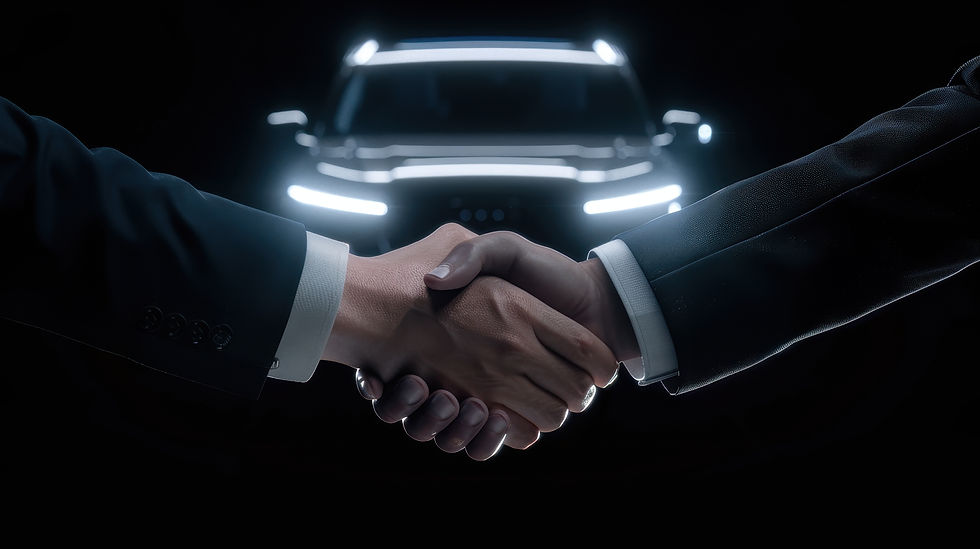
As we noted in our August ICYMI, the industry learned that the best way forward might be together. We first spotted this in late 2024 with "Bromances on Wheels" … and it only accelerated.
The Pragmatist's Pivot
After years of moonshot promises, OEMs collectively took a breath. Honda's hybrid strategy pivot acknowledged that customers want choice, not mandates.
Our September "Pragmatist's Revolution" captured an industry trading "move fast" for "move smart." We'd been tracking this since February 2024, when Ford's research found only 4% of consumers were ready for EVs, despite half agreeing they were the future. The industry finally stopped building bridges with press releases and started listening.
Detroit's Chess Game
When tariff pressures mounted, Detroit pivoted at sports car speed. As we chronicled in "Tariff Gambit" and "Tariff-Proof & Tech-Smart," OEMs played defense on trade policy while running offense on customer experience – a high-wire act executed with surprising grace.
| Three Trends to Watch in 2026
1. Software Eats the Steering Wheel
We've tracked Software Defined Vehicles since our October 2022 "Automobiles Going Soft(ware)" edition. By June 2023, Hyundai and Porsche were reorganizing divisions around SDV development.
In 2026, this graduates from industry initiative to customer expectation. GM's SDVerse marketplace, OnStar going standard across all models, subscription features expanding into performance modes and dynamic insurance – vehicle ownership becomes a living, evolving relationship.
CX Implications: Contact centers will field increasingly complex software-related inquiries, from subscription management to OTA update troubleshooting. Technical support teams need training on features that didn't exist when the vehicle left the lot.
Dealer service networks require real-time coordination as software issues blur the line between "call support" and "bring it in." The OEMs who integrate their customer care, technical support and dealer communication into a seamless ecosystem will own the relationship.
2. The Coopetition Economy Accelerates
The partnerships of 2025 were just the opening lap. Watch for shared platforms, joint battery ventures and collaborative charging networks that make brand boundaries irrelevant to customers.
We tracked this evolution from GM and Stellantis jointly investing in Niron's rare-earth-free magnet technology in late 2023. When Mercedes considers BMW engines and Amazon turns car buying into one-click shopping, the old competitive playbook needs recycling.
CX Implications: Shared platforms mean shared complexity. Customers won't care that their vehicle uses a competitor's powertrain. They'll expect seamless support regardless. Expert technical support becomes critical as agents navigate multi-brand ecosystems. Reacquired vehicle management grows more nuanced as components cross brand lines. The winners will be CX partners who can support vehicles holistically, not just by badge.
3. AI Earns Its Learner's Permit
We kicked off 2025 with "404 Driver Not Found: Your Car's AI Revolution Is Loading..." and "Silicon Dreams and Electric Schemes: CES 2025's AI Takeover". Two posts that captured the industry's recalibration from autonomous driving's overpromises to AI's more pragmatic role. The lesson learned: AI works best as a co-pilot, not a replacement driver. That same philosophy now extends beyond the vehicle itself to transform the entire customer experience.

In 2026, AI matures across every touchpoint. In the vehicle: predictive maintenance that actually predicts, personalized cabin experiences that learn your preferences, and smart insurance rewarding good driving in real time. In the customer journey: contact centers with intelligent routing and real-time agent assistance, predictive days-down tracking that flags vehicles before they approach lemon law thresholds, and accelerated digital payment processing through AI-streamlined claims assessment.
Think learner's permit, not racing license, whether the AI is learning to navigate roads or customer conversations.
CX Implications: The autonomous driving setbacks taught us a crucial lesson that now shapes our entire CX strategy: customers don't want AI replacing human expertise; they want AI augmenting it. The magic happens in the blend. Technology that knows when to assist and when to step back, empowering agents rather than replacing them. After years of overpromised autonomy, customers crave AI that makes their human interactions more effective, not obsolete.
| THE ROAD AHEAD
Looking back at nearly eight years of ICYMI editions, the patterns are unmistakable. We wrote about connected cars in 2017, tracked the autonomous hype cycle through disillusionment, documented the EV revolution's fits and starts, the chip shortage chaos and the pandemic's digital acceleration. Through it all, one truth has remained constant: the winners put customer experience at the center of every decision.
2025 proved the industry performs best when it listens more than it lectures. The pivot from mandates to choice. The shift from rivalry to partnership. The evolution from hype to practical assistance. These weren't retreats, they were an industry finally reading the room.
Here's to a new tradition, another year of twists and turns and the road ahead. It's never looked more interesting.


Comments