

Build Together, Think Smarter, Press Here


CX Insights - Trend Watch - Automotive Industry (ICYMI May 2026)
If April was the month the industry got real about affordability, May was the month it got creative about solutions. Across boardrooms, factory floors and infotainment screens, the same instinct kept surfacing: the challenges ahead are too big and too fast for any one company to navigate alone. Back in our December Year-End Recap, we named coopetition and AI as two of three forces that would define 2026. Five months in, the evidence is hard to argue with. Somewhere in the middle of all the strategy decks, the industry also quietly brought back the button. More on that shortly.
Let’s dig in.
| THE GREAT COOPETITION WAVE
In our December 2025 Year-End Recap, we named coopetition as one of three forces that would define 2026. By February, it had earned its own dedicated section as Ford and Geely entered manufacturing talks, Nissan explored Honda hybrid powertrains, and Mercedes and BMW quietly discussed sharing engines. At the time, it felt like a trend worth naming. By May, it feels like an industry operating model.
The deals this month speak for themselves. Stellantis and Jaguar Land Rover signed a non-binding MOU to explore product and technology development specifically for the U.S. market. Two brands with genuinely complementary strengths decided that shared engineering is smarter than parallel spending. Ford is in advanced talks to sell part of its Valencia, Spain, plant to Geely, turning excess capacity into a strategic asset while potentially gaining access to Geely’s modular platform for a future Ford model.
Stellantis, never one to stop at one move, is using its Spanish plants to manufacture Leapmotor EVs for the European market while simultaneously committing $1.17 billion with Dongfeng to produce Peugeot and Jeep NEVs in Wuhan for global export. VW and Rivian are already building on their joint software architecture. And CEO Antonio Filosa said it plainly: partnerships are now embedded in Stellantis’ roadmap, not optional.
For customers, this shift matters more than it might appear. When OEMs share platforms and engineering costs, more investment reaches the product and the experience. The brands choosing partnership are betting that collaboration is not just a survival strategy but, increasingly, a customer experience strategy too. And for those of us who called it in December, May is a very satisfying month.
| AI DIDN’T JUST SHOW UP, IT SHOWED UP EVERYWHERE
This month AI appeared in two very different places in the automotive world – one the customer will never see, and one they’ll touch every time they get behind the wheel. Both matter.
On the factory side, AI isn’t just coming for the vehicle, it’s coming for the way the vehicle gets built. Back in January, we covered AI learning to read a driver’s mood at CES. By May, it’s redesigning the factory that builds the car.

General Motors is using AI to compress vehicle design cycles from months to days, transforming hand-drawn sketches into fully realized 3D models in hours and running aerodynamic simulations in minutes that previously took weeks.
At JLR, complex aero jobs that once took four hours now take one minute. Nissan is targeting a 30-month development window, down from the industry standard of 40 to 50, by automating software coding and unit testing.
Stellantis went further still, announcing a partnership with Accenture and NVIDIA to build high-fidelity digital twins of its manufacturing plants using NVIDIA Omniverse – virtual replicas of real facilities where production can be simulated, validated and optimized before a single physical change is made.
And Honda is investing in analog computing technology reportedly 100 times more energy-efficient than standard GPUs, a quiet bet on neuromorphic chips that could redefine how AI runs inside future vehicles entirely.
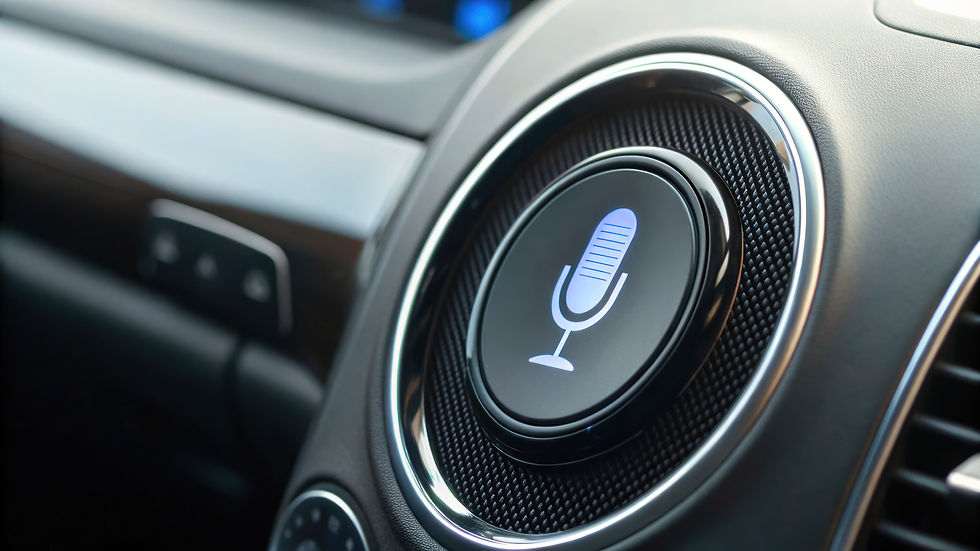
On the dashboard side, Hyundai launched Pleos Connect, a next-generation infotainment system, targeting 20 million vehicles by 2030. The system features Gleo, a large language model AI assistant that manages vehicle functions through natural conversation. GM, meanwhile, is rolling out Google Gemini to 4 million vehicles already on the road, one of the largest generative AI deployments in the industry, leveraging 30 years of OnStar connectivity as its foundation.
The factory floor of 2030 will look as different from today’s as today’s looks from 1990’s. And the dashboard of 2030 will feel less like an interface and more like a conversation.
So the future is talking to you. The present just wants a knob it can trust.
| JUST FOR FUN: SIGNS OF THE TIMES
The automotive industry spent most of May talking about billion-dollar alliances and AI reshaping everything from factory floors to infotainment screens. Then the Wards 10 Best Interiors & UX judges delivered their verdict … and the loudest message wasn’t about AI at all. It was about knobs.
In a year defined by digital transformation, the vehicles earning the industry’s most coveted interior award were the ones that remembered humans have hands. Judges specifically rewarded the return of tactile controls alongside digital screens, citing ease of use and reduced driver distraction.
The $45,000 Volkswagen Tiguan made the list partly because it offers massaging seats – a feature that not long ago required a six-figure price tag. And Hyundai’s new Pleos Connect, for all its AI ambition, made a deliberate point of keeping physical buttons for core controls. Because some things, it turns out, should just click.
The future is software-defined. The present, apparently, still appreciates a good knob.
CX REALITY CHECK
AI is redesigning the factory and redefining the dashboard. The next frontier is figuring out where it belongs in the customer relationship and where it doesn’t.
Not every interaction is AI-ready. Some are AI-enabled but human-delivered. Knowing the difference is becoming one of the most important strategic decisions an OEM can make. A Gleo assistant answering a navigation question at 70 miles per hour is AI-ready. A customer calling because their connected service didn’t activate correctly after three attempts is AI-enabled, human-delivered. A renewal conversation with a subscriber who hasn’t engaged in six months is human, full stop.
We explored exactly this balance in our white paper Where Heart Meets Tech: Elevating Human Potential with AI in the Contact Center. The brands that get this right won’t just have smarter cars and faster factories. They’ll have customers who feel seen at every touchpoint, including before the sale, after the sale and every software update in between.
Here’s to June – may your algorithms be sharp and your humans be sharper.


Comments